
Are ethicists more ethical than other people? Philosopher Eric Shwitzgebel has investigated this at some length and basically says no. He suggests this is because ethicists think of themselves as employed to think about ethics, not to be personally more ethical, and they are just not any more ethically ambitious than other people.
To find out if ethicists are more ethical, he checked how well they behave according to commonly held moral views. How much they steal library books, how much they call their mothers, how often they eat meat, and so on.
This seems like a poor way to judge the ethicalness of ethicists. Unless I am mistaken, the whole point of doing ethics research is to change our understanding of ethics. Successful ethics research then should lead to aiming to be ‘less ethical’, all things equal, if the measure of ethicalness is agreement with pre-existing or commonsense ethical norms.
Similarly, if your navigator directs you along a different route to the one you would have guessed, this suggests your navigator might actually be adding value.
The more troubling claim is that ethicists are apparently about as ethical as other people, rather than less ethical. This is not all that damning, since popular ethics is mostly deontological, and you could rearrange a lot of human behavior without much affecting adherence to a few deontological constraints. For instance, you can change which charities you give to substantially without affecting whether you give to charity and whether you kill anyone directly. Also, presumably a given ethicist studies some narrow set of activities, and is unlikely to have made progress on calling her mother aberrantly or whatever you happen to ask her about.
Ethicists like Peter Singer do manage to have views that at least sound like an ethical step backwards to the average person. Which seems like a good sign about whether they might be getting anywhere with the research.
I actually doubt that ethicists are much more ethical than other people. I just object to concluding that they are not with experiments that wouldn’t tell you if they were.
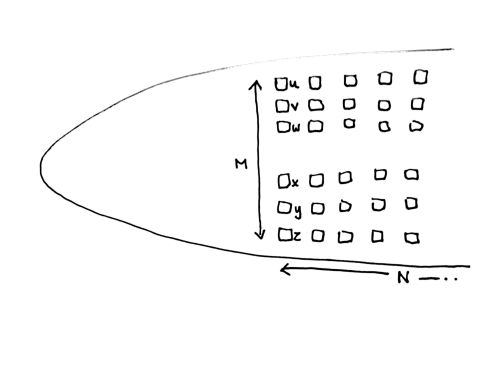 The standard routine by which people exit a plane looks like this. First, about two thirds of the people positioned next to the aisle stand up and prepare their items to leave. Then the first two or so walk off the plane (the people from seats x and w in the diagram). Then the two people in seats v and y get out, prepare their things, and walk off. Then u and z do that. Then the next couple of people in the original queue walk off, allowing the people in their row to climb out, get their stuff, and leave. And so on, for every row.


 Meteuphoric