Category Archives: 1

Subconscious stalking?

Just seeing another person look at something can tend to make you like it a bit more than if you see them looking in another direction:

In this study, we found that objects that are looked at by other people are liked more than objects that do not receive the attention of other people (Experiment 1). This suggests that observing averted gaze can have an impact on the affective appraisals of objects in the environment. This liking effect was absent when an arrow was used to cue attention (Experiment 2). This underlines the importance of other people’s interactions with objects for generating our own impressions of such stimuli in the world.

The authors suggest this is because people really do tend to look at things more if they like them, and that another person likes something is information about its value. This makes sense, and even more if we assume that the ancestral environment contained fewer eye catching people paid to prominently give items their attention.
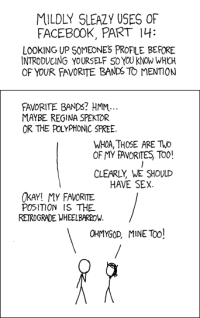
Is observing the eye movement of others an earlier version of facebook? (picture: xkcd.com)

Is observing the eye movement of others a precursor to facebook? (picture: xkcd.com)

Another possibility though is that people want to have coinciding tastes to those around them often, so we are not so much interested in clues to the item’s inherent value, but directly in the other person’s values. In that case if we evolved nicely we would react more to some people looking than to others.

Sure enough, this study found that such an effect seems to hold for attractive people, but not unattractive:

In a conditioning paradigm, novel objects were associated with either attractive or unattractive female faces, either displaying direct or averted gaze. An affective priming task showed more positive automatic evaluations of objects that were paired with attractive faces with direct gaze than attractive faces with averted gaze and unattractive faces, irrespective of gaze direction. Participants’ self-reported desire for the objects matched the affective priming data.

Added: These days we can discover (and adapt to) many people’s likes and dislikes prior to meeting them extensively, as long as they post them all over Facebook or the like. If the tendency to coordinate our values based on minor cues was good enough to evolve, does the possibility of doing so much more effectively via online stalking give a selective advantage to those who use it?

Freedom is slavery

These comparisons are sometimes made as arguments in favor of the former in each pair being forcibly prevented:

  • Selling equity in yourself is like slavery
  • Allowing organ selling is like stealing organs
  • Choosing genetic characteristics of your children is like eugenics
  • Languages dying out is like genocide
  • Selling babies is like slavery, or is like stealing babies and selling them
  • Sweatshops are like slavery
  • Euthenasia is like murder
  • Prostitution is like rape
  • Globalization is like colonialism
  • Any more to add?

The general pattern:

Freely chosen X is like X coerced. And as X coerced is bad, we should prevent X (coercively if need be).

Why is this error prevalent? I suspect it stems from assuming value to be in goods or activities, rather than in the minds of their beholders. Consent is important because it separates those who value something enough to do it and those who don’t. Without the idea that people value things different amounts, consent seems just another nice thing to have, but not functional. If most people wouldn’t make a choice unless forced, then that choice is bad, then others making it should be stopped.

Bought kidneys look like stolen kidneys; can you spot the difference?

Bought kidneys look like stolen kidneys; can you spot the difference?

I wonder if this is related to the misunderstanding that trade must be exploitative, because employers gain and the gain must come from somewhere. This also appears to stem from overlooking the possibility that people place different values on the same things, so extra value can be created by exchange.

This is related.

The puzzle continues

A puzzle from ages ago:

What do these things have in common? Nerves, emotions, morality, prices.

Continue reading

Do fetching models stave off shallowness?

Many complain that prevalent advertising portraying an inaccurate proportion of humanity as inhumanly attractive causes people to think attractiveness is more important than it should be. This is unlikely.

Prevalent advertising portraying an inaccurate proportion of humanity as too attractive is blamed for misinforming people on the value of attractiveness.

Unattractive females, both self rated and judged externally, find features of male physical attractiveness, such as facial masculinity and voice, less appealing than attractive females do.

This study suggests such behavior is to avoid wasting effort on guys who won’t be interested. That hypothesis beats the others because women’s preferences adapt fast to circumstances. In the study women saw pictures of other women who were more or less attractive. As their own perceived attractiveness went down or up accordingly, their preferences for male facial masculinity did too.

Do physically unattractive people actually believe one another to be hot? This study suggests not:

When less attractive people accept less attractive
dates, do they persuade themselves that the people they
choose to date are more physically attractive than others
perceive them to be? Our analysis of data from the popular
Web site HOTorNOT.com suggests that this is not the
case: Less attractive people do not delude themselves into
thinking that their dates are more physically attractive
than others perceive them to be.

When less attractive people accept less attractive dates, do they persuade themselves that the people they choose to date are more physically attractive than others perceive them to be? Our analysis of data from the popular Web site HOTorNOT.com suggests that this is not the case…

Instead, same study suggests that less attractive people claim to put greater weight on other characteristics than attractiveness in mate choice:

..participants’ own attractiveness was significantly correlated with their standardized weights for physical attractiveness (r 5 .60, prep 5 .98), but negatively correlated with their standardized weights for sense of humor (r 5 .44, prep 5 .91). Overall, these results suggest that more attractive people and less attractive people consider different criteria in date selection: Less attractive people tend to place less weight on physical attractiveness and greater weight on non-attractiveness-related attributes such as sense of humor.

Together these pieces of research suggests that encouraging everyone to feel less attractive should decrease the adoration people (at least claim to) direct at the best looking of us and bring about more appreciation of traits which we consider more virtuous to care about. One method for achieving this, similar to the one shown effective in an above study, would be to surround everyone with pictures of super-attractive models. The advertising industry is making steady progress on this front, yet is blamed for encouraging society to care about looks. Would we be even more shallow without this stream of superior gorgeousness?

Value for money kills?

Indonesian SODIS users (picture: SODIS Eawag)

Indonesian SODIS users (picture: SODIS Eawag)

SODIS is a cheap method of disinfecting water by putting it in the sun. Like many things, it works better in physics than society, where its effects were not significant, according to a study in PLoS medicine recently. The technical barrier is that people don’t do it much. About thirty two percent of participants in the study used the system on a given day. If you’re familiar with how little things work in reality, this is still surprising. Cheaply disinfecting water seems like it would be a hit with poor people whose children get diarrhea all the time and regularly die. Rural Bolivia, where the study was done, is a good candidate. The children studied usually get diarrhoea four times a year, which causes about fifteen percent of deaths of children under five. For the poorest quintile in Bolivia the under five death rate is about one in ten of those born alive.

The leader of the study, Daniel Mausezahl, suspects a big reason for this is that lining up water bottles on your roof shows your neighbors that you aren’t rich enough to have more expensive methods of disinfecting water. It’s hard to see from a distance the difference between chlorination and coliform-infested jerry cans, so drinking excrement can make you look better than drinking cheap clean water.

Fascinating as signaling explanations are, this seems incredible. Having live descendents is even more evolutionarily handy than impressing associates. What other explanations could there be? Perhaps adults are skeptical about effectiveness? There is apparently good evidence it works though, and there were intensive promotional campaigns during the study. What’s more, lack of evidence doesn’t usually stop humans investing in just about anything that isn’t obviously lethal in the absence of effective means to control their wellbeing. And parents are known for obsessive interest in their children’s safety. What’s going on?