Tag Archives: psychology

Choosing the right amount of choice

The TED talk which I have seen praised most often is Barry Shwartz’s Paradox of Choice. His claim is that the ‘official dogma of all Western industrial societies’ – that more choice is good for us – is wrong. This has apparently been a welcome message for many.

Barry thinks the costs of choice are too high at current levels. His reasons are that it increases our expectations, makes us focus on opportunity costs rather than enjoying what we have, paralyzes us into putting off complicated or important choices, and makes us blame ourselves rather than the world when our selections fail to satisfy. We can choose how much choice to have usually though. You can always just pick a random jar of jam from the shelf if you find the decision making costly. So implicit in Barry’s complaint is that we continually misjudge these downsides and opt for more choice than we should.

Perhaps he is right currently, but I think probably wrong in the long term. Why should we fail to adapt? Even if we can’t adapt psychologically, as inability to deal with choices becomes more of a problem, more technologies for solving it will be found. Having the benefits of choice without the current costs doesn’t appear an insoluble problem.

One option for allowing more choice about choice, while keeping some benefits of variety is to have a standard default option available. Another that seems feasible is using a barcode scanner on a phone, connected to product information and an equation for finding the net goodness of products according to the owner’s values (e.g. goodness = -price – 1c per calorie – 1c per 10 miles travelled + 10c per good review – $100m for peanut traces + …). This could avoid a lot of time spent comparing product information on packages by instantly telling you which brand you likely prefer. Systems for telling you which music and films and people you are likely to like based on previous encounters are improving.

I suspect for many things we would prefer to make very resource intensive choices, because we want to make them ourselves. Where we want to have unique possessions that we identify with, each person needs to go through a similar process of finding out product information and assessing it. We don’t want to know once and for all which is most likely to be the best car for most people. Neither do we want to have randomized unique clothing. We usually want our visible possessions to reflect a choice. This isn’t a barrier to improving our choice making though. Any system that gave a buyer the best few options according to their apparent taste, for them to make the final decision, should probably keep the nice parts of choosing while avoiding time spent on disappointing options.

How much choice is good for us depends a lot on the person. Those far out on relevant bell curves will benefit more from access to more obscure options, while the most normal people will do better by going with the standard option without much thought. One level of choice will not suit all and nor will it have to. We will choose to keep and improve our choice of choices.
Trust in the adoration of strangers

Attractive people are more trusting when they think they can be seen:

Here, we tested the effects of cues of observation on trusting behavior in a two-player Trust game and the extent to which these effects are qualified by participants’ own attractiveness. Although explicit cues of being observed (i.e., when participants were informed that the other player would see their face) tended to increase trusting behavior, this effect was qualified by the participants’ other-rated attractiveness (estimated from third-party ratings of face photographs). Participants’ own physical attractiveness was positively correlated with the extent to which they trusted others more when they believed they could be seen than when they believed they could not be seen. This interaction between cues of observation and own attractiveness suggests context dependence of trusting behavior that is sensitive to whether and how others react to one’s physical appearance.

Probably rightly so. It’s interesting that people do not get used to the average level of good treatment expected for their attractiveness, but are sensitive to the difference in treatment when visible and when not. Is it inbuilt that we should expect some difference there, or is it just very noticeable?

I wonder whether widespread beauty enhancement increases overall trust in society, and enhances productivity accordingly, or whether favorable treatment and returned trust both adapt to relative position. Does advertising suggesting that the world is chock full of model material decrease trust between real people?

Dominant characters on the left

From Psyblog:

Research finds that people or objects moving from left to right are perceived as having greater power (Maass et al., 2007):

  • Soccer goals are rated as stronger, faster, even more beautiful when the movement of the scorer is from left to right, rather than right to left.
  • Film violence seems more aggressive, more painful and more shocking when the punch is delivered from left to right, compared with right to left.
  • Cars in an advert are rated as stronger and faster when they are moving from left to right, rather than right to left (take note advertising executives!).

Perhaps it’s no coincidence that athletes, cars and horses are all usually shown on TV reaching the finishing line from left to right.

According to other studies mentioned by Maass et al, in Western societies most people also tend to preferentially imagine events evolving from left to right, picture the situations in subject-verb-object sentences with the subject on the left of the object, look at new places rather than old ones more when stimuli show up in a left to right order, memorize the final positions of objects further along the implied path more when they are moving left to right, imagine number lines and time increasing from left to right, and scan their eyes over art in a left to right trajectory.

Why is this?

It seems likely that this left to right bias has its roots in language… people who speak languages written from right to left like Arabic or Urdu … display the same bias, but in the opposite direction.

So Maass and the others guessed that characters perceived as more active would also tend to be depicted on the left of more passive characters in pictures. Their research agreed:

We propose that spatial imagery is systematically linked to stereotypic beliefs, such that more agentic groups are envisaged to the left of less agentic groups. This spatial agency bias was tested in three studies. In Study 1, a content analysis of over 200 images of male–female pairs (including artwork, photographs, and cartoons) showed that males were over-proportionally presented to the left of females, but only for couples in which the male was perceived as more agentic. Study 2 (N = 40) showed that people tend to draw males to the left of females, but only if they hold stereotypic beliefs that associate males with greater agency. Study 3 (N = 61) investigated whether scanning habits due to writing direction are responsible for the spatial agency bias. We found a tendency for Italian-speakers to position agentic groups (men and young people) to the left of less agentic groups (females and old people), but a reversal in Arabic-speakers who tended to position the more agentic groups to the right. Together, our results suggest a subtle spatial bias in the representation of social groups that seems to be linked to culturally determined writing/reading habits.

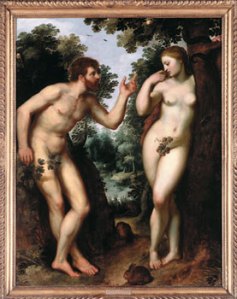
Adam appeared on the left in 62% of paintings considered, far less than Gomez Addams is portrayed on the left of Mortissa (82%). (Picture: Peter Paul Rubens)

Adam appeared on the left in 62% of paintings considered, far less than Gomez Addams is portrayed on the left of Mortissa (82%). (Picture: Peter Paul Rubens)

Note that the first study only looked at four couples; Adam and Eve, Gomez and Mortissa Addams, Fred and Wilma Flinstone, and Marge and Homer Simpson. The last three were compared to surveyed opinions on the couple’s relative activeness, dominance and communion, and the Flinstone and Simpson couples were found to be about equal. An earlier study also found that Gabriel was portrayed to the left of Mary 97% of the time.

Most languages also mention the (active) subject before the object, which means the active entity is on the left when written in a left-to-right language. Grammar predates writing, so if this ordering of nouns is relevant, as the researchers suggest, it seems it combines with the direction of writing to cause the left to right bias. It would be interesting to see whether natives to the few languages who put the object before the subject have this bias  in the other direction. It would also be interesting to see whether the layout of sentences more commonly influences our perceptions of the content, or whether the effect is so weak as to only have influence over years of parsing the same patterns.

Why do animal lovers want animals to feel pain?

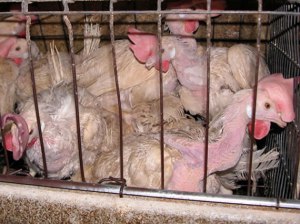
Behind the vail of (lots of) ignorance, would you rather squished chickens be painless?

Behind the vail of (lots of) ignorance, would you rather squished chickens be painless?

We may soon be able to make pain-free animals, according to New Scientist. The study they reported on finds that people not enthused by creating such creatures for scientific research, which is interesting. Robin Hanson guessed prior to seeing the article that this was because endorsing pain free animals would require thinking that farmed animals now were in more pain than wild animals, which people don’t think. However it turns out that vegetarians and animal welfare advocates were much more opposed to the idea than others in the study, so another explanation is needed.

Robert Wiblin suggested to me that vegetarians are mostly in favor of animals not being used, as well as not being hurt, so they don’t want to support pain-free use, as that is supporting use. He made this comparison:

Currently children are being sexually abused. The technology now exists to put them under anaesthetic so that they don’t experience the immediate pain of sexual abuse. Should we put children under anaesthetic to sexually abuse them?

A glance at the comments on other sites reporting the possibility of painless meat suggests vegetarians cite this along with a lot of different reasons for disapproval. And sure enough it seems mainly meat eaters who say eliminating pain would make them feel better about eating meat. The reasons vegetarians (and others) give for not liking the idea, or for not being more interested in pain-free meat, include:

  • The animals would harm themselves without knowing
  • Eating animals is bad for environmental or health reasons
  • Killing is always wrong
  • Animals have complex social lives and are sad when their family are killed, regardless of pain
  • Animals are living things [?!]
  • There are other forms of unpleasantness, such as psychological torture
  • How can we tell they don’t feel pain?
  • We will treat them worse if we think they can’t feel it, and we might be wrong
  • There are better solutions, such as not eating meat
  • It’s weird, freaky, disrespectful
  • It’s selfish and unnecessary for humans to do this to animals

Many reasonable reasons. The fascinating thing though is that vegetarians seem to consistently oppose the idea, yet not share reasons. Three (not mutually exclusive) explanations:

  1. Vegetarians care more about animals in general, so care about lots of related concerns.
  2. Once you have an opinion, you collect a multitude of reasons to have it. When I was a vegetarian I thought meat eating was bad for the environment, bad for people who need food, bad for me, maybe even bad for animals. This means when a group of people lose one reason to hold a shared belief they all have other reasons to put forward, but not necessarily the same ones.
  3. There’s some single reason vegetarians are especially motivated to oppose pain-free meat, so they each look for a reason to oppose it, and come across different ones, as there are many.

I’m interested by 3 because the situation reminds me of a pattern in similar cases I have noticed before. It goes like this. Some people make personal sacrifices, supposedly toward solving problems that don’t threaten them personally. They sort recycling, buy free range eggs, buy fair trade, campaign for wealth redistribution etc. Their actions are seen as virtuous. They see those who don’t join them as uncaring and immoral. A more efficient solution to the problem is suggested. It does not require personal sacrifice. People who have not previously sacrificed support it. Those who have previously sacrificed object on grounds that it is an excuse for people to get out of making the sacrifice.

The supposed instrumental action, as the visible sign of caring, has become virtuous in its own right. Solving the problem effectively is an attack on the moral people – an attempt to undermine their dream of a future where everybody longs to be very informed on the social and environmental effects of their consumption choices or to sort their recycling really well. Some examples of this sentiment:

  • A downside to recreating extinct species with cloning is that it will let people bother even less about stopping extinctions.
  • A recycling system where items are automatically and efficiently sorted at the plant rather than individually in homes would be worse because then people would be ignorant about the effort it takes to recycle.
  • Modern food systems lamentably make people lazy and ignorant of where their food comes from.
  • Making cars efficient just lets people be lazy and drive them more, rather than using real solutions like bikes.
  • The internet’s ready availability and general knowledge allows people to be ignorant and not bother learning facts.

In these cases, having solved a problem a better way should mean that efforts to solve it via personal sacrifice can be lessened. This would be a good thing if we wanted to solve the problem, and didn’t want to sacrifice. We would rejoice at progress allowing ever more ignorance and laziness on a given issue. But often we instead regret the end of an opportunity to show compassion and commitment. Especially when we were the compassionate, committed ones.

Is vegetarian opposition to preventing animal pain an example of this kind of motivation? Vegetarianism is a big personal effort, a moral issue, a cause of feelings of moral superiority, and a feature of identity which binds people together. It looks like other issues where people readily claim fear of an end to virtuous efforts.  How should we distinguish between this and the other explanations?

Subconscious stalking?

Just seeing another person look at something can tend to make you like it a bit more than if you see them looking in another direction:

In this study, we found that objects that are looked at by other people are liked more than objects that do not receive the attention of other people (Experiment 1). This suggests that observing averted gaze can have an impact on the affective appraisals of objects in the environment. This liking effect was absent when an arrow was used to cue attention (Experiment 2). This underlines the importance of other people’s interactions with objects for generating our own impressions of such stimuli in the world.

The authors suggest this is because people really do tend to look at things more if they like them, and that another person likes something is information about its value. This makes sense, and even more if we assume that the ancestral environment contained fewer eye catching people paid to prominently give items their attention.

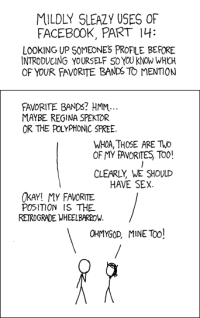
Is observing the eye movement of others an earlier version of facebook? (picture: xkcd.com)

Is observing the eye movement of others a precursor to facebook? (picture: xkcd.com)

Another possibility though is that people want to have coinciding tastes to those around them often, so we are not so much interested in clues to the item’s inherent value, but directly in the other person’s values. In that case if we evolved nicely we would react more to some people looking than to others.

Sure enough, this study found that such an effect seems to hold for attractive people, but not unattractive:

In a conditioning paradigm, novel objects were associated with either attractive or unattractive female faces, either displaying direct or averted gaze. An affective priming task showed more positive automatic evaluations of objects that were paired with attractive faces with direct gaze than attractive faces with averted gaze and unattractive faces, irrespective of gaze direction. Participants’ self-reported desire for the objects matched the affective priming data.

Added: These days we can discover (and adapt to) many people’s likes and dislikes prior to meeting them extensively, as long as they post them all over Facebook or the like. If the tendency to coordinate our values based on minor cues was good enough to evolve, does the possibility of doing so much more effectively via online stalking give a selective advantage to those who use it?