Category Archives: 1

Why are humans soft?

Softer, easier, less technical subjects: the ones about algorithmically sophisticated self-replicating nano-machinery-based robots with human-level intelligence that were constructed using selection effects, and their elaborate game theoretic interactions. e.g. sociology, economics, psychology, biology.

Harder, more difficult, more technical subjects: the ones about numbers, shapes, simple substances, rocks, making and moving macro-objects, algorithms. e.g. math, physics, chemistry, geology, engineering, computer science.

Why are the easy subjects about super-complicated, hard to understand things and the hard subjects about relatively simple things?

The first theory that comes to mind (perhaps because I’ve heard it before) is that the ‘easy’ subjects are just too hard. Nobody can get anywhere in them, which does two things. It means those subjects don’t accrue any hard-to-learn infrastructure of concepts and theories. And it completely undermines their use as a costly signal of ability to get somewhere in a subject. This leaves these subjects disproportionately popular among people who wouldn’t have been able to send that particular signal in any case, and empty of difficult concepts and theories. Worse, once the capable people leave, the body of useful science grows even more slowly and interest in the subject becomes a worse signal of competence.

Or less cynically, the capable people reasonably go to subjects that are feasible to make progress on, where they can contribute social value.

At any rate, the easy subjects are seen as hard because they have more sophisticated science, and are full of impressive people. They are hard to play at a socially acceptable level, because the frontier is more sophisticated and the competition is stiff.

On this theory, in ancient times rocket science was probably left up to the least capable members of the tribe, while pointy stick science was the place for impressive technical expertise. Which sounds pretty plausible to me.

I’m not sure if this theory really makes sense of the evidence. The kinds of subjects that are too hopeless for a capable person to perceptibly outperform a fool in are the ones like ‘detailed turbulence prediction’. People do actually make progress in soft sciences, and it would be surprising to me if those people were not disproportionately capable. It might be that the characteristic scale of progress is smaller relative to the characteristic scale of noise, so a capable person can less surely show their virtue. But it is less clear that that generally aligns with subjects being harder. For instance, if you need a certain level of (skill + luck) to find breakthroughs, and breakthroughs become harder to find, then more skilled people would at least sometimes be at an advantage.

Another explanation is that everyone feels like they understand subjects relating to humans much more than they feel like they understand physics, because (as humans) human-related things come up a lot for them, so they have relevant intuitions and concepts. These intuitions may or may not constitute high quality theories, and these concepts may or may not be the most useful. However they do make soft subjects look simple and feel understandable.

I have heard this theory before, but I think mostly as an explanation by social scientists for why people are annoying. If it also explains why the hard sciences are easy, that would nicely simplify things.

Are there other good theories?


The meaningful action treadmill

Steven Pinker describes ‘the euphemism treadmill’:

People invent new “polite” words to refer to emotionally laden or distasteful things, but the euphemism becomes tainted by association and the new one that must be found acquires its own negative connotations.

“Water closet” becomes “toilet” (originally a term for any body care, as in “toilet kit”), which becomes “bathroom,” which becomes “rest room,” which becomes “lavatory.”

“Garbage collection” turns into “sanitation,” which turns into “environmental services.”

I think a similar thing can happen with actions that are intended to carry meanings that are contrary to the context in which they are used.

For instance, eating ice cream is a happy activity. Snuggling up in bed is a happy activity. So if you are unhappy, you might try cuddling up in bed and eating ice cream. Eventually eating ice cream in bed becomes a depressing activity because it is what you do when you are unhappy. So now you have to move to some other activity that is still happy. Activities don’t become unhappy instantly, so each one can still cheer you up for a bit.

This naturally happens in the direction of good things coming to be associated with badness. The opposite associations happen too—intrinsically bad things come to be associated with goodness—but I think there is no particular treadmill in that direction. At the time of writing this, I am undressed in a half made bed on a mattress on the floor in a darkened room with little furniture at noon, and the floor is decorated with used glasses, and discarded clothes. Such situations are perhaps intrinsically depressing, but right now it just seems like what having a goal looks like, so it seems nice. In this direction, there is a negative feedback instead of a positive one. If sitting in a messy room is less depressing than usual, I’m less inclined to change to a new activity.

Recommend what the customer wants

I asked:

Suppose you are in the business of making charity recommendations to others. You have found two good charities which you might recommend: 1) Help Ugly Children, and 2) Help Cute Children. It turns out ugly children are twice as easy to help, so 1) is the more effective place to send your money.

You are about to recommend HUC when it occurs to you that if you ask other people to help ugly children, some large fraction will probably ignore your advice, conclude that this effectiveness road leads to madness, and continue to support 3) Entertain Affluent Adults, which you believe is much less effective than HUC or HCC. On the other hand, if you recommend Help Cute Children, you think everyone will take it up with passion, and much more good will be done directly as a result.

What do you recommend?


Here are some of my own thoughts.

First, it depends on what you are claiming to do.

If you claim to be recommending ‘something good’, or ‘something better than EAA’ or anything that is actually consistent with recommending HCC, then probably you should recommend HCC. (This ignores some potential for benefit from increasing the salience of effective giving to others by recommending especially effective things).

If you claim to be recommending the most effective charity you can find, then recommending HCC is dishonest. I claim one shouldn’t be dishonest, but people do have different views on this. Setting aside any complicated moral, game theoretic and decision theoretic issues, dishonestly about recommendations seems likely to undermine trust in the recommender in the medium run, and so ultimately lead to the recommender having less impact.

You could honestly recommend HCC if you explicitly said that you are recommending the thing that is most effective to recommend (rather than most effective to do). However this puts you at odds with your listeners. If you have listeners who want to be effective, and have a choice between listening to you and listening to someone who is actually telling them how to be effective, they should listen to that other person.

Perhaps there should just be two different recommendations for different groups of people? An ‘effective’-labeled recommendation of HUC for effectiveness-minded people who will do it, and a something-else-labeled recommendations of HCC for other people. (Some readers last time suggested something like this).

I think this makes things better (modulo costs and complication), but doesn’t resolve the conflict. Now you have two categories of people, and for each category there is a most effective thing to suggest to them, and a most effective thing for them to do.

The main conflict would disappear if the most effective thing for you to recommend on the values you are using was also the most effective thing for your listeners to do, on their values and in their epistemological situation.

I think a reasonable approximation of this might be to choose the set of values and epistemological situation you want to cater to based on which choice will do the most good, and then honestly cater to those values and epistemological situation, and say you are. If your listeners won’t donate to HUC because they value feeling good about their donations, and they don’t feel good about helping ugly children, and you still want to cater to that audience, then explicitly add a term for feeling good about donations, say you are doing that, and give them a recommendation that truly matches their values.

This will probably often run into problems. For instance, the general problem that sometimes (often?) people’s values are too terrible to be spoken aloud, and they certainly don’t want to follow a recommendation that endorses it. e.g. perhaps they are sexist, and will in fact devalue recommendations that help girls. Yet they are not going to follow recommendations that are explicitly for effective sexist giving. This seems like a different kind of general (though closely related) problem that I won’t go into now.

In sum, I think it is dishonest to advertise HCC as the most effective charity, and one shouldn’t do it. Even if you don’t have a principled stance against dishonesty, it seems unsustainable as an advice strategy. However you might be able to honestly advertise HCC as the best charity on a modified effectiveness measure that better matches what your audience wants, and something like that seems promising to me.

Related: consequentialist-recommendation consequentialism

The escape duty

I’m going to explain one of my favorite life-improvement techniques over the past couple of years.

I thought of it as a result of talking to Ben Hoffman. He mentioned some innovation that worked for him, and sounded impossible for me. I think it was ‘regularly reflecting on what you are doing and how it could be better’ or something vague and virtuous like that. I’m a big fan of reflecting on one’s life and how to improve it, but doing it at really appropriate times seemed hard because often I’m distracted by other things, especially when things are going badly somehow. ‘Things could be better’ is not a very salient trigger upon which to act. And I had been struggling to allocate time to reflect on my life even when I actually put it in my plan for the day.

But then I realized that there was a thing I already wanted to do exactly when things were going badly—play a computer game. At the time it was a game I shall call SPP.

So I set these rules:

  1. I am not ever allowed to play SPP unless I have first gone to the place on my computer where I reflect, and written anything at all about what is going on in my life and how it could be better.
  2. If I reflect, I may then play SPP for five minutes.

This could be repeated arbitrarily often. Like, I can just swap back and forth between reflecting and playing SPP all afternoon if I want.

Consequently, every time the rest of my life became less appealing than playing SPP, I would briefly think about what was going wrong, and try to fix it. It is easy to remember to play a computer game. It is also easy (for me at least) to remember that I must not do a thing that I often want to do—much more so than it is to remember that I should do a thing that I rarely think of.

This system has worked really well for me I think. If I am feeling bad in any way, I’m very willing to reflect for an arbitrarily short time in order to be blamelessly playing a computer game for five minutes. And once I’m reflecting, I almost always do it for long enough to make a number of concrete improvements to the situation (e.g. put on noise-cancelling headphones and find some painkillers, or think of some way to make the task at hand less complicated). And I feel like this usually helps. Sometimes I become more physically comfortable. Sometimes I realize I should be doing some other activity entirely.

(Writing in particular seems more useful for me than freeform thinking—I might put down ten ideas about what is going wrong, and consider some ways to improve all of them, and then work through the list, which is too complicated for thinking.)

From the perspective of productivity, something like tens of minutes of gaming per day is a pretty good exchange for some well-timed problem solving, and probably pays for itself in terms of other dallying. From the perspective of having fun, this arrangement is more entertaining than most productivity hacks, because it allows me to play computer games about as much as I feel like.

There have been times when I have just gone back and forth between playing games and reflecting for many iterations. For instance, when I’m sick or have a bad headache. I think the likely alternative in those cases would often be to just focus entirely on escapism, and adding the short bouts of iterative improvement has helped me to actually escape from needing escapism faster.

It helps that playing a computer game is a natural response to a variety of problems for me (lack of motivation, physical pain, distractions, anxiety, social distress), but my guess is that other people feel the same way about other procrastinations. I got tired of SPP and didn’t have a new game for a while, which I think made my life worse. Lately I have found another one, and have picked this habit back up again.

I expect there are many reasons this won’t work for other people, but maybe it will for some, and maybe some variant on the underlying idea is useful. I think the underlying idea is something like this: instead of trying to remember to do X at time Y, find thing Z that you generally want to do at time Y, and prohibit it always without X. Or less generally: make some beloved source of procrastination contingent on a small amount of agentic contemplation of your problems.

Meteuphoric games

Back to the original, titular purpose of this blog: getting excited about how things are metaphors for other things. Here are some things that are structurally similar in that they are games where you try to find structural similarities.

They also share the properties of being amusing to me and not generally known, so I thought I’d share them. I don’t know if they are generally amusing—if you try one, feel free to leave a comment about whether you enjoyed it or not.

1. My thought is like…

This is a game I learned as a child. It goes like this:

Kate: [thinks of a thing] My thought is like –

Sarah: Sam Smith

Robert: the word of God

Kate: actually it was a palm tree

Sarah: Hmm, but Sam Smith is basically just like a palm tree. They are both tall, covered with a sparse brown fur, and appreciate dryness. Also, you’ve been thinking about them lately. Also, you are disproportionately interested in getting your hands on their nuts.

Robert: But palm trees are well known to symbolize the word of God. Probably because when you are lost in a metaphorical desert, God’s word guides you to the oasis of salvation. That’s why the faithful carry them on Palm Sunday.

Kate: Sarah makes the best case.

Sarah: [thinks of a thing] My thought is like-


2. Crosswords where every clue points to two words that fit in the crossword

Really, making them is the game that most involves finding structural similarities in things—solving them involves the opposite.

For instance, what sentence could you use to describe either of these words at once?

CALVE and CARVE. Maybe, ‘an action that increases the matching items of cow you have’

NET and SET. Maybe, ‘Contains things that share a certain property’

LOADED and LOANED. ‘His family could drive a Tesla because it was ——‘

Here’s one I made earlier, but it’s not great. Here’s a famous crossword that probably inspired this activity indirectly.


3. Explain everything in terms of status

One player asks for an explanation of some phenomenon. Others give answers that make the phenomenon largely about status. The first player chooses the best explanation. For warning, I made this game up and have not played it properly. Improper variants are amusing to me, but I’m not sure if to others.

Example: Why do we sleep?

Evolution bothered to develop eyes and ears and legs and flight or fight responses and the tendency to look around sharply if you hear something suspicious in large part because it is extremely dangerous to have no idea what is going on in your environment, and to not be able to run away from it. Yet after all this wariness, animals just shut down, paralyzed, and ignore everything for some large fraction of the time. If this seems potentially very costly, that’s because it is a kind of costly signaling.

One of the main threats to an animal is other animals of the same species. And an important way to fend off attacks from animals of the same species is to make and advertise social alliances. Sleep is a costly signal of having good social alliances. It shows that you trust that you won’t be killed, even if your own activities make it trivially easy to kill you. Looking relaxed and at ease is the universal signal that you believe your opponent would be insane to fight you, because you can beat them from a position of being relaxed and at ease. Being so relaxed that you wouldn’t even notice if you were in a fight is the universal signal that others have got your back.

This also helps explain why people who are scared or lonely find it hard to sleep, and why people who are closely allied like to sleep together.


4. Constrained bananagrams: matching triplets

Bananagrams is a game lots of people play. I think I made up the variant where you add constraints. e.g. each word has to rhyme with at least one other word in your grid, or all the words have to be verbs. The matching triplet constraint is that each word must be part of a triplet of words in your grid for which you can give an explanation for why they are basically similar. I think I haven’t actually tried this version with another person because I’ve run out of people in my immediate vicinity who are willing to play variants of bananagrams with me. This one seems somewhat harder than other variants, which are generally substantially harder than Bananagrams.

20160515_102130

In progress game. If I had an opponent, they may not accept that ‘drug’, ‘bot’ and ‘desk’ are things that can make various online conversation partners less coherent.

20151109_221547

Bananagrams constrained to rhyming words

20151114_221102

I forget what the constraint was here, but I think it was fun.


5. Codenames with Dixit cards

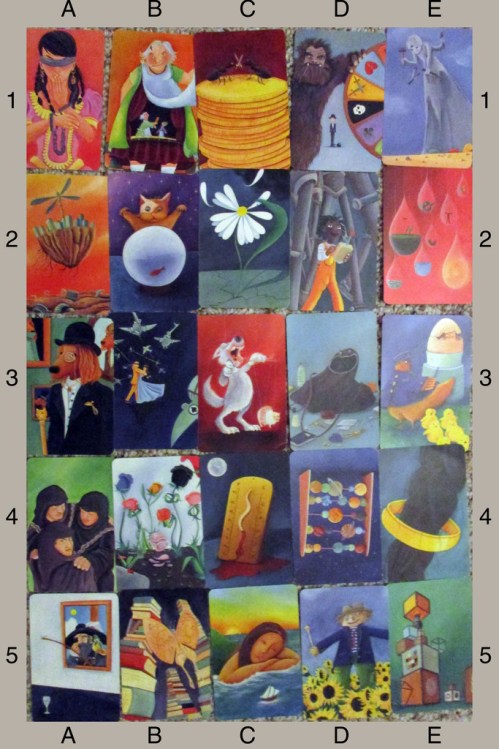
Codenames is a real game that basically involves trying to give someone a clue that points to four or five of twenty or so words another person is looking at, without cluing the rest. My friends and I like to play the game with Dixit cards instead of words. According to the internet we are not the first to think of this.

pic2664878_lg

A Codenames grid made from Dixit cards. If you were by chance assigned to clue the first eight cards, you might say ‘sword 4’ and hope that 1B and 1E are more swordy than anything else around. I can’t think of anything really good to say here. Picture from Contigo at BoardGameGeek

***

Do you know any more good games for this list?