Category Archives: 1

Good intuitions

Sometimes people have ‘good intuitions’. Which is to say something like, across a range of questions, they tend to be unusually correct for reasons that are hard to explain explicitly.

How do people come to have good intuitions? My first guess is that new intuitions are born from looking at the world, and naturally interpreting it using a bunch of existing intuitions. For instance, suppose I watch people talking for a while, and I have some intuitions about how humans behave, what they want, what their body language means, and how strategic people tend to be. Then I might come to have an intuition for how large a part status plays in human interactions, which I could then go on to use in other cases. If I had had different intuitions about those other things, or watched different people talking, I might have developed a different intuition about the relevance of status.

On this model, when a person has consistently unusually good intuitions, it could be that:

A) Their innate intuition forming machinery is good: perhaps they form hypotheses easily, or they avoid forming hypotheses too easily. Or they absorb others’ useful words into their intuitions easily.

B) They had a small number of particularly useful early intuitions, that tend to produce good further intuitions in the presence of the outside world.

C) They have observed more or higher quality empirical data across the areas where they have superior intuitions.

D) They got lucky, and randomly happen to have a lot of good intuitions instead of bad intuitions.

Which of these plays the biggest part seems important, for:

  • Judging intuitions in hard or unusual areas: If A), then good intuitions are fairly general. So good intuitions about math (testable) suggest good intuitions about how to avoid existential risk (harder to test). This is decreasingly the case as we move down the alphabet.
  • Spreading good intuitions: If B), then it might be possible to distill the small number of core intuitions a person with good intuitions has, and share them with other people.

I expect some of all of A-D play a part (and that I have forgotten more possibilities). But are some of them particularly common in people who have surprisingly good intuitions?

Ethicists should look less ethical

Are ethicists more ethical than other people? Philosopher Eric Shwitzgebel has investigated this at some length and basically says no. He suggests this is because ethicists think of themselves as employed to think about ethics, not to be personally more ethical, and they are just not any more ethically ambitious than other people.

To find out if ethicists are more ethical, he checked how well they behave according to commonly held moral views. How much they steal library books, how much they call their mothers, how often they eat meat, and so on.

This seems like a poor way to judge the ethicalness of ethicists. Unless I am mistaken, the whole point of doing ethics research is to change our understanding of ethics. Successful ethics research then should lead to aiming to be ‘less ethical’, all things equal, if the measure of ethicalness is agreement with pre-existing or commonsense ethical norms.

Similarly, if your navigator directs you along a different route to the one you would have guessed, this suggests your navigator might actually be adding value.

The more troubling claim is that ethicists are apparently about as ethical as other people, rather than less ethical. This is not all that damning, since popular ethics is mostly deontological, and you could rearrange a lot of human behavior without much affecting adherence to a few deontological constraints. For instance, you can change which charities you give to substantially without affecting whether you give to charity and whether you kill anyone directly. Also, presumably a given ethicist studies some narrow set of activities, and is unlikely to have made progress on calling her mother aberrantly or whatever you happen to ask her about.

Ethicists like Peter Singer do manage to have views that at least sound like an ethical step backwards to the average person. Which seems like a good sign about whether they might be getting anywhere with the research.

I actually doubt that ethicists are much more ethical than other people. I just object to concluding that they are not with experiments that wouldn’t tell you if they were.

Aisle seat theorizing

I recently went on some planes. Here is what I think about whenever I go on a plane.

A basic plane has N rows of M seats, divided by an aisle. For instance, maybe N=50 and M=6.
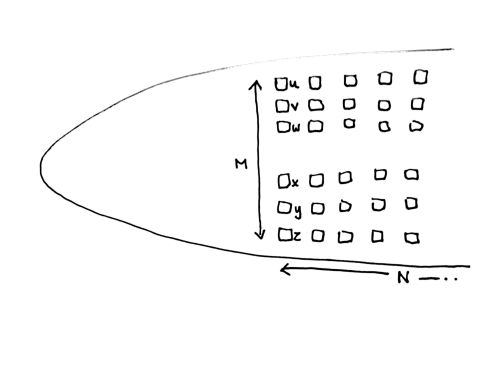
New Doc 10_1The standard routine by which people exit a plane looks like this. First, about two thirds of the people positioned next to the aisle stand up and prepare their items to leave. Then the first two or so walk off the plane (the people from seats x and w in the diagram). Then the two people in seats v and y get out, prepare their things, and walk off. Then u and z do that. Then the next couple of people in the original queue walk off, allowing the people in their row to climb out, get their stuff, and leave. And so on, for every row.

Let:
A be the time it takes to prepare one’s things to go
B be the time it takes to walk one seat forward in the plane (such that it takes the last person NB to walk from their seat to the front of the plane)

Then the time it takes for the usual procedure is:

time for one row to depart * number of rows + time for last person to walk off

= number of people in a row * time to take your stuff and step forward for the next person to get out * number of rows + number of rows * time to walk forward one row

= M(A+B) * N + BN

= AMN + BMN + BN

Here is an alternative method. Everyone in row Q stands and collects their things. They all walk off the plane. Row R stands and repeats the process. And so on.

Here is how long this procedure would take:

time for one column to depart * number of columns

= (time for a person to get their stuff + time for each person to move one seat forward, allowing the person behind them to start walking + time for the last person to walk all the way off) * number of columns

= (A + B(2N-1)) * M

= AM + 2BMN – BM

(In both cases I assumed that each person can only start walking forward after the person in front of them has moved one seat forward. So the last person in line takes B(N-1) time to start moving, and then BN time to get out. This is probably not quite right, but near enough.)

It might not be intuitively obvious, but in general AMN + BMN + BN is much bigger than AM + 2BMN – BM, if we assume it takes substantially longer to collect your bags than it does to walk a couple of steps forward. In fact, it is (A-B)M(N-1) + BN bigger, if we assume that I can do algebra.

For example if there are fifty rows (N = 50) of 6 seats (M = 6), and gathering your stuff takes ten seconds, and walking forward one seat takes one second, we have:

usual method
= AMN + BMN + BN
= 10*6*50 + 1*6*50 + 1*50
= 3350 seconds

alternative method
= AM + 2BMN – BM
= 10*6 + 2*6*50*1 – 1*6
= 654 seconds

Intuitively, if a whole column can get their stuff together at once, that is a lot faster than everyone standing waiting while one person at the front gets their stuff. It’s bad if A gets multiplied by MN.

Each method is bottlenecked by something happening MN times – as many times as there are seats on the plane. In one case, we are bottlenecked by each person taking their stuff down one at a time and then taking a step forward. In the other, it is just the time it takes to walk forward one seat.

You can’t hope to be faster than about 2BMN: the time it would take for every person to walk off the plane in single file if they wait for the person ahead of them to move one seat forward before they start walking. So my proposed method is not much worse than theoretically optimal.

You might notice that the time to completely empty the plane isn’t the same as the time lost, because how bad it is for the plane to not be emptied yet depends on how many people there are still in it. If people leave fairly evenly throughout the disembarking process, the utilitarian cost is roughly time*total people/2. Intuitively, each person is there for half the time the plane is disembarking. This means the total time is proportional to the value lost, so we can ignore this factor. People don’t quite get out evenly throughout the process in these two procedures, but near enough.

Probably the algebra in this post is wrong in places, but I think the gist is correct.

So, the alternative method seems superior to me. Why isn’t it used?

Anecdotal uncertainty of pain

My experience of pain seems to be somewhat different from that of other people. For instance, for much of the day I wrote this I thought I was probably in pain, though I was unsure exactly where, or how bad it was, or if it was really pain instead of something else. To be clear, it was still unpleasant and fairly distracting.

Sometimes I feel like everything is terrible for five minutes or so before figuring out that the problem is that I’m in physical pain. I even explicitly wonder whether the problem is pain, and decide probably not, before later realizing I was wrong. In such cases I infer that I was in pain all along because it feels more like a picture emerging after staring at a bunch of dots for long enough, rather than something in the world changing. Also, I don’t have any other good explanation for what was so bad earlier.

I point this out because I think the usual folk theory of pain says that pain is a kind of direct experience that you can’t really be confused about. If you don’t know if you are in pain, you aren’t. Pain is a conscious experience, so being in pain implies being aware that you are in pain. Also knowing what the pain is like. I think I kind of assumed something like this until I paid more attention to my own experiences, or until my own experiences became more incomprehensible on this model. I don’t have a well worked out alternative model (maybe others do), but I expect it should the possibility of being consciously confused about basically everything.

I’m also curious about whether I am especially unusual in this regard, or just tend to hear from people who are surprised by this. Are you ever unsure whether you are in pain? Are you ever unsure about its characteristics?

Therapy and materialistic accounts of behavior

I used to see a therapist. Every week they would give me actions to take in the coming week. For instance, fill out a sheet about panic attacks immediately after any panic attacks that I had. Or, do a mindfulness exercise about once per day, at a time when I was anxious. 

It seemed to me that it order for any of these things to happen with high probability, I would need to immediately do something to cause them to happen. For instance, think about what symptoms of anxiety should trigger the mindfulness exercise and try to imagine them happening and exactly what I hope to do then. Or make a note to put the panic attack sheet under the honey that I eat if I’m having a panic attack. Or at least make a note in my todo list to figure out how to make these things happen later. 

Being somewhat anxious is just not sufficiently salient and distinctive that I’m going to think ‘oh hey, anxiety—what do I do now?’ And whatever it is that the therapist wanted me to do is also not sufficiently memorable or unique that I will think of it. This may sound implausible, but remember that I have several other things going in life besides paying attention to my own anxiety, many of which also involve paying attention to things, or doing things. And my therapist is far from the only source of suggestions on what I should do if I’m anxious. So just being told to do another thing one time is probably not going to make it happen.

Furthermore, if I’m actually having a panic attack, it’s a good day if I can remember to do the things that I know make it better, let alone fill out some form that’s in my bag somewhere. (Panic attacks can be associated with an extremely perceptible decrease in one’s shit being together.) So getting these weekly exercises to happen would require some actual thought.

This worldview seemed foreign to my therapist. They seemed to think that if I agreed to do a thing, then I would magically do it. Like a story character running on narrative coherence, not like a machine running on causality. 

Often I did not do the things, or did them at the wrong times. Usually because it didn’t occur to me at the relevant time, in line with my theory. (Really I should have had a standing plan to think about these things immediately after therapy each time, but I didn’t.) My therapist would emphasize to me that it is important to do the things at the right times. 

This seems like a surprising kind of failure for a therapist, assuming it is a failure. For one thing, if anyone is going to be aware that human minds don’t run on narrative magic, it should probably be psychological professionals. For another, if anyone should benefit from knowing that human minds don’t run on narrative magic—and in particular that they often need further setup in order to do a thing in the future—it should probably be that whole set of professionals who regularly try to get other random untrained humans to do specific stuff in their own time. Doctors, dentists, teachers, therapists, etc. 

I don’t know if I’ve ever seen a doctor, dentist, teacher, or therapist try to cause me to have a real, actionable plan to do something. Perhaps other people’s minds don’t need this kind of thing? My understanding is that the failure of humans to do what medical professionals ask them to do is a major headache for medical professionals. Also, I’d be surprised if I’m among the least conscientious of the people with imperfect mental health. Others’ failures to follow instructions might be for different reasons. But I think the ‘trigger action planning’ stuff at CFAR is pretty well liked, and it is basically this. 

Is this worldview—on which deciding to do a thing will not magically cause you to do it—just rare outside of the rationalist community? Have I just randomly bumped into people who don’t have it? Is it actually just not useful to therapists and other such people? Is it actually just not useful to anyone?