Category Archives: 1

Intuitions and utilitarianism

Bryan Caplan:

When backed into a corner, most hard-line utilitarians concede that the standard counter-examples seem extremely persuasive.  They know they’re supposed to think that pushing one fat man in front of a trolley to save five skinny kids ismorally obligatory.  But the opposite moral intuition in their heads refuses to shut up.

Why can’t even utilitarians fully embrace their own theory? 

He raises this question to argue that ‘there was evolutionary pressure to avoid activities such as pushing people in front of trolleys’ is not an adequate debunking explanation of the moral intuition, since there was also plenty of evolutionary pressure to like not dying, and other things that we generally think of as legitimately good. 

I agree that one can’t easily explain away the intuition that it is bad to push fat men in front of trolleys with evolution, since evolution is presumably largely responsible for all intuitions, and I endorse intuitions that exist solely because of evolutionary pressures. 

Bryan’s original question doesn’t seem so hard to answer though. I don’t know about other utilitarian-leaning people, but while my intuitions do say something like:

‘It is very bad to push the fat man in front of the train, and I don’t want to do it’

They also say something like:

‘It is extremely important to save those five skinny kids! We must find a way!’

So while ‘the opposite intuition refuses to shut up’, if the so-called counterexample is persuasive, it is not in the sense that my intuitions agree that one should not push the fat man, and my moral stance insists on the opposite. My moral intuitions are on both sides.

Given that I have conflicting intuitions, it seems that any account would conflict with some intuitions. So seeing that utilitarianism conflicts with some intuitions here does not seem like much of a mark against utilitarianism. 

The closest an account might get to not conflicting with any intuitions would be if it said ‘pushing the fat man is terrible, and not saving the kids is terrible too. I will weigh up how terrible each is and choose the least bad option’. Which is what utilitarianism does. An account could probably concord more with these intuitions than utilitarianism does, if it weighed up the strength of the two intuitions instead of weighing up the number of people involved. 

I’m not presently opposed to an account like that I think, but first it would need to take into account some other intuitions I have, some of which are much stronger than the above intuitions: 

  • Five is five times larger than one
  • People’s lives are in expectation worth roughly the same amount as one another, all else equal
  • Youth and girth are not very relevant to the value of life (maybe worth a factor of two, for difference in life expectancy)
  • I will be held responsible if I kill anyone, and this will be extremely bad for me
  • People often underestimate how good for the world it would be if they did a thing that would be very bad for them.
  • I am probably like other people in a given way, in in expectation
  • I should try to make the future better
  • Doing a thing and failing to stop the thing have very similar effects on the future.
  • etc.

So in the end, this would end up much like utilitarianism.

Do others just have different moral intuitions? Is there anything wrong with this account of utilitarians not ‘fully embracing’ their own theory, and nonetheless having a good, and highly intuitive, theory?

Reminders without times

Many times in life, a person wants to do a thing at a different time. For this to happen, the person has to remember about this, at the different time.  We have very good systems this, as long as the time can be specified in terms of time. That is, if you can say ‘I want to do this in three days’ or ‘remind me at 2pm tomorrow’, then you can look at a calendar every day, or make alarms and electronic alerts and so on. We also have reasonable systems if the other time doesn’t have to be very specific, beyond ‘later’. One can make a to-do list, or just leave the bill in the middle of the floor.

As far as I know, we have no such excellent ways to remember things at a specific point if the point is known by some other feature, such as ‘the next time at which I’m talking to my mother’, ‘next time I visit Chicago’, or ‘when I’m in a conversation and it seems awkward’.

In general, it is hard to do things when some fact obtains. This is partly because you are unlikely to be constantly checking whether that fact obtains, especially if you have many facts to check for. You can’t just go around asking yourself ‘am I having an awkward conversation? Am I driving? Am I standing up? Am I with Michael?…’. You are of course aware of all of these things anyway, in some sense. If someone asked you whether you were just driving, you would be able to respond without checking. However this does not seem to be sufficient awareness for you to reliably do a thing that you intended to do when driving. Somehow you have to both be aware of the driving, and aware of the ‘if driving, then practice singing’ implication, at the same time, and make the connection.

I’ve thought a bit about how to improve various aspects of my life, and realized after a bit  that most of them are hindered by this problem, which is why it got my attention. It seems like I could shower faster, remember new names better, and improve my posture more, if only I noticed when I was in the correct situations to behave in the ways that I would like.

One basic problem is that you can describe a situation in many ways, so even if you ask yourself often ‘what am I doing?’, your description may not involve ‘I’m standing up’, so you won’t remember that you should adopt a good posture.

Here are some suggested solutions to this problem, in case you are interested. I don’t know if any are good, but thought I should share them, since I bothered to find them:

Incentives

Reward yourself. e.g. put some candy in your pocket, and every time you pay attention to whether your conversation partner is getting a word in, you get some. Alternatively, give yourself a ‘behavioral reward’ – smile or say ‘yay’ or something. Ideally, the reward should come quickly after the behavior. As well as reinforcement, a reward that you are aware of will occasionally remind you of the desired behavior probably. e.g. when I see the pack of strawberry buttons in my bag, I remember what I have to do to get them.

Introduce a reward that you will frequently want, which can be combined with the activity. e.g. take up nicotine gum, and only chew it when you have thought about whether you are going about your current activity in a sensible manner. Always get a coffee at lunch time, then don’t sip it unless you are wearing ear plugs.

Reward yourself for even noticing the context. e.g. if you are in a conversation, and someone says their name for the first time, if you manage to say to yourself ‘hey, a name!’ then you get a prize later. Once you can do this, move up to actually taking the intended action (e.g. remembering the name).

Offer a prize to others if they notice you in the context, without doing the correct thing. e.g. give a dollar to your partner every time they see you slouching.

If you know there will be a desirable thing present at the time you should remember, then make the desirable thing contingent on remembering – e.g. if you know that at the time when you will want yourself to close your email, you will also want to look at a webcomic, allow yourself to look at the webcomic if you close your email. Hopefully at the time when you are considering whether you should look at the webcomic, you will remember that you have a great excuse to, as long as you close your email.

Count times you do the thing, or don’t do it. For instance, if you don’t want to touch your face throughout the day, a tally of the number of times you do it can help.

Make sure you don’t feel bad when you do the thing correctly, for some exogenous reason. e.g. if every time you pay extra attention to what the other party in a conversation wants to talk about, you feel guilty for not doing this naturally, you may be dissuaded from paying attention.

Social effects

Tell others that you are in favor of this thing (though I’ve also heard that committing to things publicly is actively harmful). e.g. If you tell others that you endorse thinking carefully before taking on commitments, you might feel more like the kind of person who does that, and remember to pause and evaluate the next request before agreeing to it.

Associate with people who endorse the thing. e.g. if you want to remember to speak more loudly and clearly, perhaps spend a bit of time at Toastmasters or an acting group.

Other strengthening of mental connections

Choose a more salient contextual trigger, and remember (using any of these techniques) to look for the less salient one when you see the more salient one. e.g. when you are in a lift, remember to check whether you are thinking about something pointless or good.

Visualize the connection: vividly imagine the situation that you want to do the thing in, and imagine yourself doing the thing. Put in lots of details. e.g. if you want to remember to ask an economist a particular question, next time you are talking to an economist, then think about the economists you are likely to talk to, and what economists are like in general, and the kinds of things you might be talking about with one, and the places you might be, and the kind of little cocktail sausages you might be eating, and imagine your awkward segue into this question, and asking them it, and waiting for them to answer.

Offline practice. Actually do the thing you want yourself to do, a number of times. e.g. if you want to do pushups while you wait for the microwave, then go and put something in the microwave right now and do pushups until it finishes. Then do that again, several times. (Try not to get the thing too hot).

Say out loud what you are going to do. e.g. ‘whenever I’m eating, I’m going to watch machine learning lectures’.

External reminders

Modern phone capabilities. You might be able to set it to tell you the next time you are entering the supermarket, or driving a car, etc. If not now, perhaps next time you get a phone.

Large numbers of reminders at not particularly special times. e.g. an alert which comes up on your phone or computer twenty times a day, asking if you are currently hyperventilating. I know someone who just looks through a list of possible contexts that things to remember depend on, roughly every day. e.g. Am I going to New York today? Nope. Am I going to the dentist?…

Noticeable accoutrements. e.g. if you wear a shiny bracelet, or an annoying rubber band, or an itchy sweater, you might just notice it very often. Then every time you notice it, you can say to yourself ‘am I projecting my voice right now?’. This requires you to learn the connection between seeing the shiny bling and asking the question, but that might be easier.

Sticky notes in relevant places. e.g. in your car, ‘look at the road!’.

Make the thing be at a specifiable time. e.g. set an alarm for 6pm which tells you to both eat your meal and call your mother, instead of trying to remember to call your mother whenever you happen to be eating.

Situation design

Change the situation to be one where you will more likely do the thing. If you want to remember to take a tablet with your meal, put the tablets next to the plates. If you want to remember to work out while you watch TV, put the weights in front of the TV. This kind of thing is closely related to making things easier to do, such that you can do them most of the time when you remember them, instead of mostly putting them off.

Make your routine avoid things you don’t want to happen. e.g. if you want to remember to suppress your compulsion to wash your hands, put the soap in the cupboard.

***

I repeat: I don’t know which of these work. I haven’t put a huge amount of time into it.

Should altruists pay for profitable things?

People often claim that activities which are already done for profit are bad altruistic investments, because they will be done anyway, or at least because the low hanging fruit will already be taken. It seems to me that this argument doesn’t generally work, though something like it does sometimes. Paul has written at more length about altruistic investment in profitable ventures; here I want to address just this one specific intuition which seems false.

Suppose there are a large number of things you can invest in, and for each one you can measure private returns (which you get), public returns (which are good for the world, but you don’t control),  or total returns (the sum of those). Also, suppose all returns are diminishing, so if an activity is invested in, it pays off less the next time someone invests in it, both privately and publicly.

Suppose private industry invests in whatever has the highest private returns, until they have nothing left they want to invest. Then there is a market rate of return: on the margin more investment in anything gives the same private return, except for some things which always have lower private returns and are never invested in. This is shown in the below diagram as a line with a certain slope, on the private curve.

investment1 copy

Total returns and private returns to different levels of investment.

There won’t generally be a market rate of total returns, unless people use the total returns to make decisions, instead of the private returns.  But note that if total returns to an endeavor are generally some fraction larger than private returns (i.e. positive externalities are larger than negative ones), then the rates of total returns available across interventions that are invested in for private good  should generally be higher than the market rate of private returns.

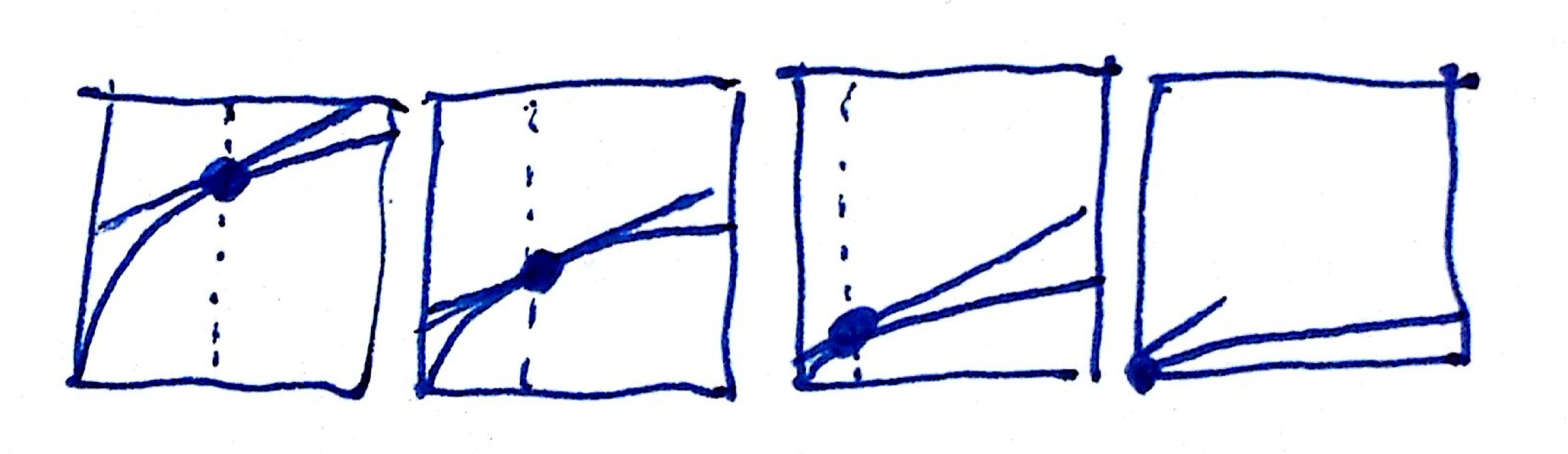
So, after the market has invested in the privately profitable things, the slope of every private returns curve for a thing that was invested in at all will be the same, except those that were never invested in. What do you know about those things? That the their private returns slope must be flatter, and that they have been invested in less.

investment 2 copy

Private returns for four different endeavors. Dotted lines show how much people have invested in the endeavor before stopping. At the point where people stop, all of the endeavors have the same rate of returns (slope).

What does this imply about the total value from investing in these different options? This depends on the relationship between private value and total value.

Suppose you knew that private value was always a similar fraction of total value, say 10%. Then everything that had ever been invested in would produce 10x market returns on the margin, while everything that had not been would produce some unknown value which was less than that (since the private fraction would be less than market returns). Then the best social investments are those that have already been invested in by industry.

If, on the other hand, public value was completely unrelated to private value, then all you know about the social value of an endeavor that has already been funded is that it is less than it was initially (because of the diminishing returns). So now you should only fund things that have never been funded (unless you had some other information pointing to a good somewhat funded opportunity).

The real relationship between private value and total value would seem to lie between these extremes, and vary depending on how you choose endeavors to consider.

Note on replaceability

Replaceability complicates things, but it’s not obvious how much it changes the conclusions.

If you invest in something, you will lower the rate of return for the next investor in that endeavor, and so will often push other people out of that area, to invest in something else in the future.

If your altruistic investments tend to displace non-altruists, then the things they will invest in will less suit your goals than if you could have displaced an altruist. This is a downside to investing in profitable things: the area is full of people seeking profits. Whereas if altruists coordinate to only do non-profitable things, then when they displace someone, that person will move to something closer to what the displacing altruist likes.

In a world where social returns on unprofitable things are generally lower than social returns on profitable things though, it would be better to just displace a profit-seeking person who will go and do something else profitable and socially useful, unless you have more insights into the social value of different options than represented in the current model. If you do, then altruists might still do better by coordinating to focus on a small range of profitable and socially valuable activities.

For the first case above, where private value is a constant fraction of total value, replaceability is immaterial. If people move out of your area to invest in another area with equal private returns, they still create the same social value. Though note that with the slightly lower rate of returns on the margin, they will consume a bit more instead of investing. Nonetheless, as without the replaceability considerations, it is best here to invest in profitable ventures.

In the second case, where private and public returns are unrelated, investing in something private will push people to other profitable interventions with random social returns. This is less good than pushing altruists to other unprofitable interventions, but it was already better in this case to invest in non-profitable ventures, so again replaceability doesn’t change the conclusion.

Consider an intermediate case where total returns tend to be higher than private returns, but they are fairly varied. Here replaceability means that the value created from your  investment is basically the average social return on random profitable investments, not on the one you invest in in particular. On this model, that doesn’t change anything (since you were estimating social returns only from whether something was invested in or not), but if  you knew more it would. The basic point here though is that just knowing that something has been invested in is not obviously grounds to think it is more or less good as a social investment.

Conclusions

If you think the social value of an endeavor is at least likely to be greater than its private value, and it is being funded by private industry, you can at least lower bound its total value at market returns. Which is arguably a lot better than many giving opportunities that nobody has ever tried to profit from.

Note that in a specific circumstance you may know other things that can pin down the relationship between private and total value better. For instance, you might expect self-driving cars to produce total value that is many times greater than what companies can internalize, whereas you might expect providers of nootropics to internalize a larger fraction of their value (I’m not sure if this is true). So if hypothetically the former were privately invested in, and the latter not, you would probably like to invest more in the former.

How to buy a truth from a liar

Suppose you want to find out the answer to a binary question, such as ‘would open borders destroy America?’, or ‘should I follow this plan?’. You know someone who has access to a lot of evidence on the question. However you don’t trust them, and in particular, you don’t trust them to show you all of the relevant evidence. Let’s suppose that if they purport to show you a piece of evidence, you can verify that it is real. However since they can tell you about any subset of the evidence they know, they can probably make a case for either conclusion.  So without looking into the evidence yourself, it appears you can’t really employ them to inform you, because you can’t pay them more when they tell the truth. It seems to be a case of ‘he who pays the piper must know the tune’.

But here is a way to hire them: pay them for every time you change your mind on the question, within a given period. Their optimal strategy for revealing evidence to make money must leave you with the correct conclusion (though maybe not all of the evidence), because otherwise they would be able to get in one more mind-change by giving you the remaining evidence. (And their optimal strategy overall can be much like their optimal strategy for making money, if enough money is on the table).

This may appear to rely on you changing your mind according to evidence. However I think it only really requires that you have some probability of changing your mind when given all of the evidence.

Still, you might just hear their evidence, and refuse to officially change your mind, ever. This way you keep your money, and privately know the truth. How can they trust you to change your mind? If the question is related to a course of action, your current belief (a change of which would reward them) can be tied to a commitment to a certain action, were the period to end without further evidence provided. And if the belief is not related to a course of action, you could often make it related, via a commitment to bet.

This strategy seems to work even for ‘ought questions’, without the employee needing to understand or share your values.

Why would info worsen altruistic options?

One might expect that a simple estimation would be equally likely to overestimate or underestimate the true value of interest. For instance, a back of the envelope calculation of the number of pet shops in New York City seems as likely to be too high as too low.

Apparently this doesn’t work for do-gooding. The more you look into an intervention, the worse it gets. At least generally. At least in GiveWell’s experience, and my imagination. I did think it fit my real (brief) experience in evaluating charities, but after listing considerations I considered in my more detailed calculation of Cool Earth’s cost-effectiveness, more are positive than negative (see list at the end). The net effect of these complications was still negative for Cool Earth, and I still feel like the other charities also suffered many negative complications. However I don’t trust my intuition that this is obviously strongly true. More information welcome.

In this post I’ll assume charitable interventions do consistently look worse as you evaluate them more thoroughly, and concern myself with the question of why. Below are a number of attempted explanations for this phenomenon that I and various friends can think of.

Regression to the altruistic intervention mean

Since we are looking for the very best charities, we start with ones that look best. And like anything that looks best, these charities will tend to be less good than they look. This is an explanation Jonah mentions.

In this regression to the mean story, which mean is being regressed to? If it is the mean for charities, then ineffective charities should look better on closer inspection. I find this hard to believe. I suspect that even if a casual analysis suggests $1500 will give someone a one week introduction to food gardening, which they hope will reduce their carbon footprint by 0.1 tonnes per year, the real result of such spending will be much less than the tonne per $1000 implied by a simple calculation. The participant’s time will be lost in attending and gardening, the participants probably won’t follow up by making a garden, they probably won’t keep it up for long, or produce much food from it, and so on. There will also be some friendships formed, some leisure and mental health from any gardening that ultimately happens, some averted trips to the grocery store. My guess is that these positive factors don’t make up for the negative ones any better than they do for more apparently effective charities.

Regression to the possible action mean + value is fragile

Instead perhaps the mean you should regress to is not that of existing charities, but rather that of possible charities, or – similarly – possible actions. This would suggest all apparently positive value charities are worse than they look – the average possible action is probably neutral or negative. There are a lot of actions that just involve swinging your arms around or putting rocks in your ears for instance. Good outcomes are a relatively small fraction of possible outcomes, and similarly, good plans are a probably a relatively small fraction of possible plans.

Advertising

The initial calculation of a charity’s cost-effectiveness usually uses the figures that the charity provided you with. This information might be expected to be both selected for being optimistic looking, whether due to outright dishonesty, or selection from among a number of possible pieces of data they could have told you about.

This seems plausible, but is hard to believe as the main effect I think. For one thing, in many of these cases it would be hard for the charity to be very selective – there are some fairly obvious metrics to measure, and they probably don’t have that many measures of them. For instance, for a tree planting charity, it is very natural for them to tell us how many trees they have planted, and natural for us to look at the overall money they have spent. They could have selected a particularly favorable operationalization of how many trees they planted, but there still doesn’t seem to be that much wiggle room, and this wouldn’t show up (and so produce a difference between the early calculation and later ones) unless one did a very in-depth investigation.

Common relationships tend to make things worse with any change

Another reason that I doubt the advertising explanation is that a very similar thing seems to happen with personal plans, which appear to be less geared toward advertising, at least on relatively non-cynical accounts. That is, if I consider the intervention of catching the bus to work, and I estimate that the bus takes ten minutes and comes every five minutes, and it takes me three minutes to walk at each end, then I might think it will take me 13-18m to get to work. In reality, it will often take longer, and almost never take less time.

I don’t think this is because I go out of my way to describe the process favorably, but rather because almost every change that can be made from the basic setup – where I interact with the bus as planned and nothing else happens – makes things slower rather than faster. If the bus comes late, I will be late. If the bus comes more than a few minutes early, I will miss it and also be late. Things can get in the way of the bus and slow it down arbitrarily, but it is hard for them to get out of the way of the bus and speed it up so much. I can lose my ticket, or not have the correct change, but I can’t benefit much from finding another ticket, or having more change than I need.

These kinds of relationships between factors that can change in the world and the things we want are common. Often a goal requires a few inputs to come together, such that having extra of an input doesn’t help if you don’t have extra of the others, yet having less of one wastes the others. Having an extra egg doesn’t help me make more cake, while missing an egg disproportionately shrinks the cake. Often two things need to meet, so moving either of them in any direction makes things worse. If I need the eggs and the flour to meet in the bowl, pouring either of them anywhere different will cause destruction.

This could be classed under value being fragile, but I think it is worth pointing out the more specific forms this takes. In the case of charities, this might apply because you need a number of people to meet together in the same place as a vaccination clinic has been set up, at the same time as some nurses, and as a large number of specific items.

This might explain why things turn out in practice to be worse than they were in plans, however I’m not sure this is the only thing to be explained. It seems that also if look at plans in more depth (without seeing the messy real-world instantiation) you become more pessimistic. This might just be because you remember to account for the things that might go wrong in the real world. But looking at the Cool Earth case, these kinds of effects don’t seem to account for any of the negative considerations.

Negative feedbacks

Another common kind of relationship between things in the real world is the one where if you change a thing, it produces a force which pushes it back the way it came. For instance, if you donate blankets to the poor, they will acquire fewer blankets in other ways, so in total they will not have as many more blankets as you gave them. Or if you be a vegetarian, the price of meat will go down a little, and someone else will eat more meat. This does account for a few of the factors in the Cool Earth case, so that’s promising. For instance, protecting trees changes the price of wood, and removing carbon from the atmosphere lowers the rate at which other processes remove carbon from the atmosphere.

Abstraction tends to cause overestimation

Another kind of negative consideration in the Cool Earth case is that saving trees really only means saving them from being logged with about 30% probability. Similarly, it only means saving them for some number of years, not indefinitely. I think of these as instances of a general phenomenon where a thing gets labeled as something which makes up a large fraction of it, and then reasoned about as if it entirely consists of that thing. And since the other things that really make it up don’t serve the same purpose in the reasoning, estimates tend to be wrong in the direction of the thing being smaller. For instance, if I intend to walk up a hill, I might conceptualize this as involving entirely walking up the hill, and so make a time estimate from that. Whereas in fact, it will involve some amount of pausing, zigzagging, and climbing over things, which do not have the same quality of moving me up the hill at 3mph. Similarly, an hour’s work contains some non-work often, and a 300 pound cow contains some things other than steaks.

But, you may ask, shouldn’t the costs be underestimated too? And in that case, the cost-effectiveness should come out the same. That does seem plausible. One thought is that prices are often known a lot better than the value of whatever they are prices on, so there is perhaps less room for error. e.g. you can see how much it costs to buy a cow, due to the cow market, but it’s less obvious what you will get out of it. This seems a bit ad hoc, but on the other hand some thought experiments suggest to me that something like this is often going on when things turn out worse than hoped.

Plan-value

If you have a plan, then that has some value. If things change at all, then your plan gets less useful, because it doesn’t apply so well. Thus you should be expected to consistently lose value when reality diverges from your expectations in any direction, which it always does. Again, this mostly seeks to explain why things would turn out worse in reality than expected, but that could explain some details making plans look worse.

Careful evaluators attend to negatives

Suppose you are evaluating a charity, and you realize there is a speculative reason to suspect that the charity is less good than you thought. It’s hard to tell how likely it is, but you feel like it roughly halves the value. I expect you take this into account, though it may be a struggle to do so well. On the other hand, if you think of a speculative positive consideration that feels like it doubles the value of your charity, but it’s hard to put numbers on it, it is more allowable to ignore it. A robust, conservative estimate is often better than a harder to justify, more subjective, but more accurate estimate. Especially in situations where you are evaluating things for others, and trying to be transparent.

This situation may arise in part because people expect most things to be worse than they appear – overestimating value seems like a greater risk than underestimating it does.

Construal level theory

We apparently tend to think of think of valuable things (such as our goals) as more abstract than bad things (such as impediments to those goals). At least this seems plausible, and I vaguely remember reading it in a psychology paper or two, though I can’t find any now. If this is so, then when we do very simple calculations, one might expect them to focus on abstract features of the issue, and so disproportionately the positive features. This seems like a fairly incomplete explanation, as I’m not sure why good things would naturally seem more abstract. I also find this hard to cash out in any concrete cases – it’s hard to run a plausible calculation of the value of giving to Cool Earth that focuses on abstracted bad things, other than the costs which are already included.

Appendix: some examples of more or less simple calculations

A basic calculation of Cool Earth’s cost to reduce a tonne of CO2 825,919 pounds in 2012 x 6 years/(352,000 acres x 260 tonnes/acre) = 6 pence/tonne = 10 cents/tonne

If we take into account:

  • McKinsey suggests approach is relatively cost-effective (positive/neutral)
  • Academic research suggests community-led conservation is effective (positive/neutral)
  • there are plausible stories about market failures (positive/neutral)
  • The CO2 emitted by above ground sources is an underestimate (positive)
  • The 260 tonnes/acre figure comes from one area, but the other areas may differ (neutral/positive)
  • The projects ‘shield’ other areas, which are also not logged as a result (positive)
  • Cool Earth’s activities might produce other costs or benefits (neutral/positive)
  • Upcoming projects will cost a different amount to those we have looked at (neutral/positive)
  • When forestry is averted, those who would have felled it will do something else (neutral/negative)
  • When forestry is averted, the price of wood rises, producing more forestry (negative)
  • Forests are only cleared 30% less than they would be (negative)
  • The cost they claim for protecting one acre is higher than that inferred from dividing their operating costs by what they have protected (negative)
  • The forest may be felled later (negative)
  • Similarity of past and future work (neutral)
  • other effects on CO2 from averting forestry (neutral)
  • CO2 sequestered in wood in long run (neutral)
  • CO2 sequestered in other uses of cleared land (neutral)

…we get $1.34/tonne. However that was 8 positive (or positive/neutral), 4 completely neutral, and only 5 negative (or negative/neutral) modifications.

In case you wonder, the —/neutral considerations made no difference to the calculation, but appear to be if anything somewhat ‘—‘. Some of these were not small, but only considered as added support for parts of the story, so improved our confidence but didn’t change the estimate (yeah, I didn’t do the ‘update your prior on each piece of information’ thing, but more or less just multiplied the best numbers I could find or make up together).

Examples of estimates which aren’t goodness-related:

If I try to estimate the size of a mountain, will it seem smaller as I learn more? (yes)

Simple estimate: lets say it takes about 10h to climb, and I think I can walk uphill at about 2mph => 20 mile walk. Let’s say I think the angle is around 10 degrees. Then sin(10) = height/20. Then height = 20sin10 = 3.5 miles

Other considerations:

  • the side is bumpy, so I probably walk 20 miles in less than 20 miles => mountain is shorter
  • the path up the mountain is not straight – it goes around trees and rocks and things, so I probably walk 20 miles in even less than 20 miles => the mountain is shorter
  • when I measured that I could walk at about 2mph, I was probably walking the whole time, whereas when we went up the mountain, probably I really stopped sometimes to look at things, or due to confusion about the path, or whatever, so probably I can’t walk 2mph up the mountain => the walk is probably less than 20 miles. => the mountain is shorter

If I try to estimate the temperature, will it seem lower as I learn more? (neutral)

Simple estimate: I look at the thermometer, and it says a number. I think that’s the temperature.

Further considerations:

  • the thermometer could be in the shade or the sun or the wind (neutral)
  • the thermometer is probably a bit delayed, which could go either way (neutral)
  • I may misread the thermometer a bit depending on whether my eye is even with it – this could go either way (neutral)