Does increasing peak typing speed help?

Is it worth learning to type faster? If – like me – basically what you do is type, this seems likely to be a pretty clear win, if you have any interventions that would improve it at all. Ryan Carey suggested a painful sounding intervention which improves maximum typing speed a lot, but said that since he usually types substantially below his maximum typing speed, this would not help. His model seems to be that typing speed is basically either bottlenecked by physical typing ability or something else (like thinking speed), and it is not much worth trying to speed up the one that is not bottlenecking the process. This sounds pretty reasonable, but did not match my intuitions, and seemed extremely cheap to test, so I decided to test it.

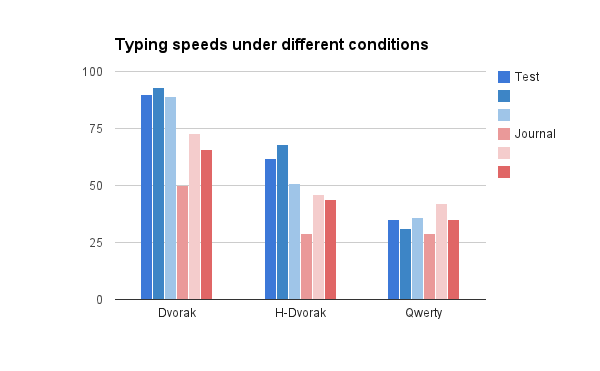
I tried a number of ways of reducing my typing speed, and chose three that were reasonably spaced across the spectrum (~90wpm, ~60wpm, ~30wpm) on a typing speed test. These were (respectively) Dvorak keyboard layout, Dvorak with my left pinky finger tied up with a rubber band or tape, and Qwerty keyboard layout. I measured each one three times on that test, and three times on longer (3-5m) journaling activities, mostly writing about issues in my life that I wanted to think about anyway. These journaling bouts tended to be faster than I would usually casually write I think, so this does not really test how much peak typing speed improves combination writing/staring into space speed. But they were slow enough to be real journaling, with some real insights, and were substantially slower than peak typing speed.

My results are below. They are a bit dubious, but I think are good enough for the purpose. Moving from the middle method to the top method improved my real speed in proportion to my peak speed. Between the bottom two, it made little difference. Further details are more confusing – that there is no difference between peak and real speed for Qwerty suggests that physical typing is a big bottleneck there, however improving the typing method to handicapped Dvorak – which has a higher peak speed – doesn’t improve real speed much either, suggesting inconsistently that thinking is a huge bottleneck, which also seems implausible if thinking is not such a big bottleneck for higher speeds (implied by the fact that real speeds get a lot higher with better typing methods). But if I wanted to think more about these things, I should probably just do some more tests. I’m not convinced this is worth it, but if anyone else does any, I’m curious to see.

Incidentally I suspect Qwerty gets a boost in journaling relative to typing tests. This is because I have to look at my hands a fair bit to do it, which is harder when you also have to look at the screen sometimes too.

I’m more inclined to trust the patterns in faster speeds, which I say is due to them being much closer to my real typing speed (from which I might improve), but could obviously be because it supports my prior intuitions.

Incidentally, a few plausible-to-me models that would fit either thinking or typing faster increasing real typing speed:

  • Thinking speed increases linearly with exogenously increased typing speed, and is usually the bottleneck – then increasing physical typing ability always increases thinking speed, as does increasing thinking speed itself.
  • You do bursts of thinking and typing, basically one at a time – then your speed is something like a weighted mean of the speeds.
  • You either type or think all the time (this is the bottlenecking activity), and do the other activity part of the time, however when you do the faster one it slows down the bottlenecking activity, so speeding up either activity speeds the entire process.


Mean speeds

Test Journal
Dvorak 91 63
H-dvorak 60 40
Qwerty 34 35

All data

Test Journal
Time 1 Time 2 Time 3 Time 4 Time 5 Time 6
Dvorak 90 93 89 50 73 66
H-Dvorak 62 68 51 29 46 44
Qwerty 35 31 36 29 42 35

Some graphs

image (1) image

Intelligence Amplification Interview

Ryan Carey and I discussed intelligence amplification as an altruistic endeavor with Gwern Branwen. Here (docx) (pdf) is a summary of Gwern’s views. Also more permanently locatable on my website.

How to trade money and time

Time has a monetary value to you. That is, money and time can be traded for one another in lots of circumstances, and there are prices that you are willing to take and prices you are not. Hopefully, other things equal, the prices you are willing to take are higher than the ones you aren’t.

Sometimes people object to the claim that time has a value in terms of money, but I think this tends to be a misunderstanding, or a statement about the sacredness of time and mundanity of money. I also suspect that the feeling that time is sacred and money is in some sense not prompts people who believe that money and time can be compared in value in principle to object to actually doing it much. There are further reasons you might object to this too. For instance, perhaps having an explicit value on your time makes you feel stressed, or cold calculations make you feel impersonal, or accurate appraisals of your worth per hour make you feel arrogant or worthless.

Still I think it is good to try to be aware of the value of your time. If you have an item, and you trade it all day long, and you don’t put a consistent value on it, you will be making bad trades all over the place. Imagine if you accepted wages on a day to day basis while refusing to pay any attention to what they were. Firstly, you could do a lot better by paying attention and accepting only the higher ones. But secondly, you would quickly be a target for exploitation, and only be offered the lowest wages.

I don’t think people usually do this badly in their everyday trading off of time and money, because they do have some idea of the trades they are making, just not a clear one. But many other things go into the sense of how much you should pay to buy time in different circumstances, so I think the prices people take vary a lot when they should not. For instance, a person who would not accept a wage below $30/h will waste an hour in an airport because they don’t have internet, instead of buying wifi for $5, because they feel this is overpriced. Or they will search for ten minutes to find a place that sells drinks for $3 instead of $4, because $4 is a lot for a drink. Or they will stand in line for twenty minutes to get the surprisingly cheap and delicious lunch, and won’t think of it as being an expensive lunch now.

I agree that time is very valuable. I just disagree that you should avoid putting values on valuable things. What you don’t explicitly value, you squander.

It can be hard to think of ways that you are trading off money and time in practice. In response to a request for these, below is a list. They are intended to indicate trade-offs which might be helpful if you want to spend more money at the expense of time or vice versa in a given circumstance. Some are  written as if to suggest that you should move in one direction or the other especially – remember that you can generally move in the opposite direction also.

Continue reading

Meta-error: I like therefore I am

I like Scott’s post on what LessWrong has learned in its lifetime. In general I approve of looking back at your past misunderstandings and errors, and trying to figure out what you did wrong. This is often very hard, because it’s hard to remember or imagine what absurd thoughts (or absences of thought) could have produced your past misunderstandings. I think this is especially because nonsensical confusions and oversights tend to be less well-formed, and thus less organizable or memorable than e.g. coherent statements are.

In the spirit of understanding past errors, here is a list of errors which I think spring from a common meta-error. Some are mentioned in Scott’s post, some were mine, some are others’ (especially those who are a combination of smart and naive I think), a few are hypothetical:

  • Because I believe agent-like behavior is obviously better than randomish reactions, I assume I am an agent (debunked!).
  • Because I think it is good to be sad about the third world, and not good to be sad about not having enough vitamin B, I assume the former is why I am sad.
  • Because I explicitly feel that racism is bad, I am presumably not racist.
  • Because my mind contains a line of reasoning that suggests I should not update much against my own capabilities because I am female, presumably I do no such thing.
  • Because I have formulated this argument that it is optimal for me to think about X-risks, I assume I am motivated to (also debunked on LW).
  • Because I follow and endorse arguments against moral realism, and infer that on reflection I prefer to be a consequentialist, I assume I don’t have any strong moral feelings about incest.
  • Because I have received sufficient evidence that I should believe Y, I presumably believe Y now.
  • I don’t believe Y, and the only reason I endorse to not believe things is that you haven’t got enough evidence for them, therefore I must not have enough evidence to believe Y.
  • Because I don’t understand the social role of Christmas, I presume I don’t enjoy it (note that this is a terrible failing of the outside view: none of those people merrily opening their presents understands the social role either).
  • Because I don’t endorse the social role of drinking, I assume I don’t enjoy it.
  • Because signaling sounds bad to me, I assume I don’t do it, or at least not as much as others.
  • Because I know the cost of standing up is small (it must be, it’s so brief and painless!), this cannot be a substantial obstacle to going for a run (debunked!).
  • I know good motives are better than bad motives, so presumably I’m motivated by good motives (unlike the bad people, who are presumably confused over whether good things are the things you should choose)
  • I have determined that polyamory is a good idea and babies are a bad idea, therefore I don’t expect to feel jealousy or any inclination to procreate, in my relationships.

In general, I think the meta problem is failing to distinguish between endorsing a mental characteristic and having that characteristic. Not erroneously believing that the two are closely related, but actually just failing to notice there are two things that might not be the same.

It seems harder to make the same kind of errors with non-mental characteristics. Somehow it’s more obvious to people that saying you shouldn’t smoke is not the same as not smoking.

With mental characteristics however, you don’t know how your brain works much at all, and it’s not obvious what your beliefs and feelings are exactly. And your brain does produce explicit endorsements, so perhaps it is easy to identify those with the mental characteristics that the endorsements are closely related to. Note that explicitly recognizing this meta-error is different from it being integrated into your understanding.

Interview with Cool Earth

An interview with the people of Cool Earth, a charity I investigated and ultimately recommended as a relatively good one while visiting GWWC last summer.